David Cronenberg is an art house director best known as the
prime practitioner of body horror, though he has expanded well beyond that in
his 40 years of filmmaking. Shivers(1975) is one of his early films. It takes place in a planned condominium
reminiscent of the high-end enclaves in J.G.Ballard’s novels High Rise and Super-Cannes. In the film a sexually
transmitted parasite runs rampant, causing uncontrollable libido in its hosts
and resultant deviance, chaos, and death. Clearly, the juxtaposition of the
setting and the increasingly twisted sexuality is rife with social commentary;
you can watch and decide for yourself if it’s effective. The character Nurse
Forsythe encapsulates the mood: “Even dying is sexual.” Not unexpectedly, Shivers met with much controversy when
it came out, but Roger Ebert was an early (somewhat hesitant) proponent
and it has come to be mostly well-regarded.
I appreciate Shivers. The
Fly may be my favorite of Cronenberg’s horror films and his most polished. The Brood might be his creepiest. His
psychological horror drama Dead Ringers,
wherein Jeremy Irons plays twin gynecologists Beverly and Elliot, is a truly
unique film and probably the one I most recommend from his early catalog. And
then there are his recent forays: his crime dramas like the great A History of Violence and Eastern Promises and the surreal,
literary Cosmopolis. His is an oeuvre
worth exploring.
You could spend a lot of time diagramming
Cronenberg’s influence, and one branch would lead you from Shivers to the 1986 cult horror comedy Night ofthe Creeps, which also showcases mind-controlling slugs. Both are
directly referenced by James Gunn’s 2006 Slither, a fun film
with a great cast – one of my favorite post-2000 horror films. I’m glad Gunn is
seeing wider success now with Guardians
of the Galaxy.
(Here’s
a Paris Review interview with J.G.
Ballard from 1984.)
I jumped back to 1971 for last night’s movie. By then the
world had seen Romero’s gory Night of the
Living Dead and the almost naturalistic evil in Polanski’s Rosemary’s Baby (both 1968). Mario Bava
expanded on Psycho’s (1960) edginess
by introducing the violent, trashy but stylish giallo in the mid-1960’s, but the genre doesn’t seem to have fully
bled over (hah) into America’s popular consciousness until later in the 70’s. And 1971 was still a few years before
the American-bred horror renaissance of Wes Craven and Tobe Hooper.
Let’s Scare Jessica To
Death (1971) has a look from the New Hollywood and the feel of a gothic tale.
When the film begins, Jessica (Zohra Lampert) is
recently out of a mental hospital and she, her husband, and a friend are
escaping the city and driving to their new home in rural Connecticut, a journey that includes a portentous river-crossing by ferry. From the
first scenes Jessica maintains a troubled internal dialogue, has visions of
ominous figures, and hears near-constant creepy breathy whispering. The film’s
first third feels as much a psychological thriller as a supernatural horror
film, and it suggests that all of the weird happenings may be borne from her madness, and it even seems possible that she is being intentionallydriven insane. It toys with this pretense until the end but it shows its
hand pretty early.
Director John D. Hancock and cinematographer Robert M. Baldwin
make great use of the old house and, especially, the pastoral setting, which seems summery
and vibrant one moment and stark and foreboding the next. The film’s other
strengths lie in its two female leads. Lampert is jaggedly vulnerable but
always comes across as a real person facing her demons (which of,
course, are probably not just her demons). Mariclare Costello plays Emily, a
mysterious drifter they find squatting in the house who quickly falls into
their lives. Costello is an interesting presence,
ethereal and magnetic in her way but with a natural roundedness that belies her
true role in the story. The film relies heavily on their performances and much
of the tension comes from the interplay of their expressions and subtle spoken hints.
Costello as Emily
I admired this film and was glad to see it after reading about it for a while. Subtle by today's standards, but spooky and interesting.
I am a fan of British filmmaker Ben Wheatley's movies. Down Terrace is a very black black comedy
with a kitchen sink aesthetic and Sightseers
is, somewhat, in the same vein; Kill List
starts with the kitchen sink and keeps the realistic style even as it ramps up
the occult trappings on the way to its surreal ending; A Field In England is a psychedelic nonlinear historical (17th
century) drama awash in English folklore and references to alchemy. I watched the latter only
a few weeks ago and, as imperfect as it might be (and I’m not sure it is – I
need at least one more viewing), I love his fearlessness and creativity of both
form and content. He really is one of the most interesting directors working
today.
Michael Smiley
is in three of Wheatley’s four films and is terrific in all of them. I came across the film Outpostwhile looking though a list of Smiley's films. It sounded like it might have undead Nazis, so I added it to the queue and watched it last night. Smiley has a secondary part behind Ray Stevenson,
who I also like. (And by the way, the more British TV and film I watch the more
I notice that they have maybe 20 actors over there, and it’s fortunate that
they’re good actors because you see one or two of them in every production.) It is the only film directed so far by Steve Barker and
it was only released on DVD in the States. The DVD only thing isn’t always such
a bad sign, I find, with lower budget films like this – maybe because
distribution and marketing costs are so high? I’m speculating, but I’ve seen
much worse films in the theaters.
In Outpost, a businessman
named Hunt hires a team of mercenaries, led by Stevenson, to guide him to an
old Nazi bunker in an Eastern Europe forest. These Nazis, it turns out, were exploring
the dark arts and melding it with twisted steampunk technology. There’s an
endless roster of films and comic books where Nazis are associated with the
mystical or the occult, including Raiders
of the Lost Ark and The Last Crusade,
of course, as well as The Keep and Hellboy. I particularly like the
charming Norwegian comic horror Nazi zombie film Dead Snow.
Outpost has the Nazis experimenting
with unified field theory (it references the apocryphal Philadelphia
Experiment) and the bad guys, when they show up, are pretty bad. Director
Barker uses some interesting animation and the setting is effectively creepy.
He makes good use of his budget and the seams don’t show much. The acting’s good
except for Richard Brake’s mysterious outback Appalachian cockney accent.
Overall, forgettable but a fun and atmospheric 90 minutes.
A maybe better Nazi horror film
So far, I’m 0/2 on new horror films this month. Neither has been terrible but neither is a great discovery, either. I hope things look up.
I was excited to see Ti West’s The
Sacrament show up on Netflix streaming a few weeks ago. His early Trigger Man (2007) was an efficient,
stripped down, effective film. I loved House
of the Devil and The Innkeepers. He’s
a good writer, has an excellent eye, and is known for slowly building tension
and then blowing it up with intense action late in the film. (The term “slow
burn” has been so often applied to his work that he’s apparently annoyed
with it; seriously, google it and his name and you’ll see). Ti West wrote and
directed The Sacrament, Amy Semeitz
and Joe Swanberg get top billing but AJ Bowen has at least as much screen time.
Semeitz and Swanberg are
two of the most prolific young filmmakers/actors in indie film and West is no
slouch either.
As excited as I was, I saved this film for October. And now
I’ve seen it and I am sadly underwhelmed. It follows a reporter, a cameraman,
and a photographer (all ostensibly from Vice magazine, in a weird media
synergy) who travel to a remote compound to check on, and maybe rescue, the
photographer’s sister (Seimetz) from a possible cult. The Sacrament looks good
and is competently constructed, building tension and dread (as we expect from
West). But the film ends up being far too conventional. Except for the presence
of the crew and some grisly shocks at the end, it might as well be a Jim Jones
docudrama. No twists, no surprises, nothing to make it stand out.
Very disappointing. So disappointing, in fact, that I stopped the credits and promptly played House ofthe Devil, which I hadn’t seen since it came out on video. It’s so indebted
to 80’s occult horror – music, hair, costumes, the grainy look of the film, the walkman dancing – that it
straddles the fence between homage and caricature. But it’s made with love and
gets every bit right. This one burns so slowly that it has its detractors, but
I find it kind of beautiful.
October has arrived. The leaves fall from the trees, the
nights grow long, and Halloween approaches. Every year around this time I watch
a slew of horror films; I watch them all year, to be truthful, but I really ramp up around Halloween – ghost stories and monster movies and an occasional
slasher flick. This year I’m starting early and I plan to stretch it out a bit.
It's cool in my house and I'm under a blanket with the dog at my side, so
it’s a good time to begin.
Tonight I watched Neil Marshall’s 2002 Dog Soldiers.
I’d seen it before, a few years back, but I wanted to revisit it because I've come to really appreciate Marshall's films since then. This is his first, three years before he made the The Descent, one of my
favorites and a film I watch every few months. Centurion is good as well, a fun comic bookish
film.
Dog Soldiers is,
of course, a werewolf film. Lycanthropes
don’t get much appreciation, being less romantic than vampires and less of an
easy vehicle for social commentary (like mindless consumerism) and modern
anxieties (like pandemics) than zombies. Still, there are some gems in the
genre. I love John Landis’ An American
Werewolf in London, and you should, too. It’s funny and scary and has likable
characters, both dead and alive. And it has Jenny Agutter, who is charming and really should have been in way more movies. I really like Joe
Dante’s The Howling as well. Both are
1981 movies. Ginger Snaps, a nice
twist on the dangerous trappings of burgeoning teenage sexuality (most horror
is metaphor, right?), is another good one.
Dog Soldiers is a strong debut. The roots of Marshall's atmospheric style show in the shadowy woods and craggy hollows. It certainly has enough gore, and the
monster effects work well enough, though I like them better during the dimly lit early scenes. He makes good use of his budget – instead of a full werewolf transformation we get instead a few Lon
Chaneyesque drop-out-of-frame-and-emerge-as-a-monster scenes, which I kind of like, and lots of hairy, taloned arms punching through windows. A
solid cast, especially Kevin McKidd (Rome) and Liam Cunningham (Game of Thrones) deliver good performances. There's a lot of wit and the dialogue is natural. So it’s fun and it has some genuine tension, especially early on. A good start to the
season.
My last month has been a harried struggle to get things together before I leave for Antarctica to look for meteorites (you can follow our blog to see how it goes). Lots of preparation, but also an excuse to buy a new camera, which I've been using a lot this week.
So I took my dog on a last walk before delivering her to my friends' house, where she will get more attention, canine company, and table scraps than I usually offer her. She'll be happy to see me when I return, but I don't think she'll have time to miss me.
I fly out tomorrow, but I drove to Atlanta to stay with friends for Thanksgiving. It was a great meal and a great time. We had radishes from the garden.
Charlie cooked the turkey in parts on the grill. Great idea, and it turned out well. We had glazed carrots with cumin, homemade rolls, and I made Brussels sprouts with figs and bacon.
And beautiful desserts, including two kinds of blueberry tarts, apple pie, pumpkin pie, and a chocolate tart. We drank champagne and Burgundy with the meal and had Noval Black port with dessert.
Afterwards, there were group pictures, taken with Charlie's exotic cameras, and a walk with the dogs.
Then Charlie beat the hell out of me in both cribbage and backgammon.
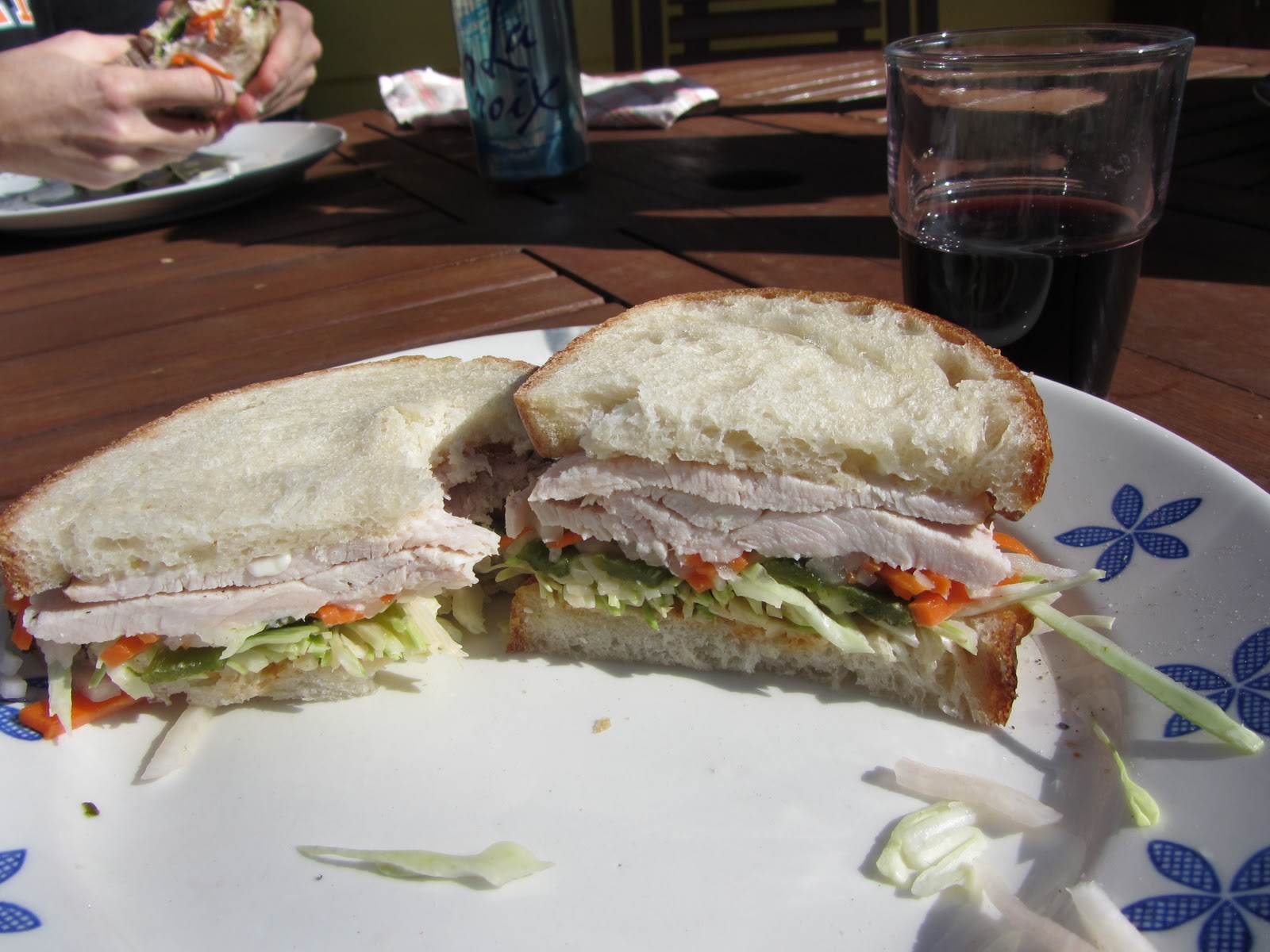
Today, we had leftovers. Maybe the best Thanksgiving sandwich ever, inspired by a banh mi. Smoked turkey, Duke's mayonnaise, sriachi, cabbage, and pickled daikon and carrots.
I hope everyone had a happy Thanksgiving. I'll be gone for a while, so I wish everyone Happy Holidays. Cheers.
I haven’t posted in a long, long time. I wrote here and on
my science blog until I realized I couldn't do that and meet my
other responsibilities. (Also, I’m a dilettante and I rarely stick with hobbies
for long.) Too bad, because I was just starting to get links from other blogs I
read and respect. I may post occasionally and mention it on Facebook.
I made paella Saturday night, and while drinking wine and
cooking, I listened to St. Vincent’s new album, Strange Mercy. I liked her previous album Actor well enough, but this one is great – my favorite of the year
so far. It’s interesting and complicated, alternately hard and ethereal, and
kind of proggy. She won me over in the interim with her badass cover of the Big Black song Kerosene,
which I watched online. As a wayward youth, that was one of my favorite songs,
and little Annie Clark owns it. Seriously, if you’re fan of Big Black, St.
Vincent, or just music, watch that. When I was in Chicago this summer for the
Pitchfork Festival, my friend Steve and I drank bourbon and watched it every
night. So, yes, Annie Clark is the best ever thing to come out of Dallas.
And on a free-association Dallas music tangent, there’s the Silver Jews
song, Dallas,
(“How’d you turn a million steers into buildings made of mirrors?”) and The
Mountain Goats song about its suburb, The Best Ever Death
Metal Band Out of Denton – someone, I don’t recall who, wrote than John
Darnielle spins whole short stories out of three minute acoustic punk songs,
and it’s true.
Paella
On the food track: Paella is a Spanish rice dish most
associated with Valencia on the eastern coast. Its name is from the Latin-derived
word for pan, and the shallow pan it’s made in is itself called a paella or a
paellera. Most recipes have chicken, shrimp, and maybe clams. Often they
include duck, rabbit, mussels, snails, or cockles. They always have saffron and
almost always Spanish chorizo. Some are especially heavy on the seafood, but mine
had chorizo, chicken, and shrimp only. Good paella should cook until the liquid
is completely absorbed or evaporated and it should have a nice crust on the
bottom.
Saffron costs more than gold by weight and Spanish chorizo
isn’t cheap, but you can make a less expensive version by substituting a bit of
turmeric for saffron and substituting chorizo with another sausage, or bacon,
and some extra smoked Spanish paprika (pimenton).
I mostly followed the recipe in The Essential New York Times Cookbook (which, if you haven’t seen
it, is awesome). I also wanted to use Mark Bittman’s technique of finishing it
in the oven from his Minimalist recipe, also in the book. Cooking it in the
oven yields some of the texture and crunch without needing the paellera or the
expertise. It’s not as pretty as traditional paella because you need to stir it
before it goes in the oven or the shrimp would be overdone. I used a 12” cast
iron skillet.
Modifications and improvements: I enjoyed the dish, and so
did my friends who tried the leftovers. The texture was right and the flavors
blended nicely, but I look forward to tweaking the recipe next time. You can
use whatever mix of stock, wine, and water you like; I mistakenly thought I had
homemade stock in the freezer, so I had to use low sodium organic chicken
stock. Homemade stock is always best, and next time I’ll follow Mark Bittman’s
recommendation to steep shrimp shells in the stock (I didn’t think of it, and I
was lazy and bought peeled shrimp). Also, I should have browned the chicken
with or after the chorizo and added it back in with the peas.
I drank a good, inexpensive Spanish Grenache (Garnacha) with
this. It held up to the spice, chorizo, and chicken. If I made paella with more
seafood I might’ve tried a white wine like Sauvignon Blanc, Alboriño,
or an Alsatian Riesling.
Recipe:
olive oil
4 oz. chorizo, sliced or diced
12 oz. chopped chicken thigh meat
1 lb. shrimp
1 cup each onion and red pepper, diced
3 large garlic cloves, minced
1 cup peas (you could use up to 2 cups, I used frozen and
thawed green peas)
1 cup chopped tomatoes
2 cups arborio rice
3 cups chicken stock
½ cup white wine
½ cup water
Red wine vinegar
Pimentón (smoked Spanish paprika)
Saffron (1/16 to 1/8 tsp., you could use ¼ tsp tumeric)
Preheat the oven to 500°. Toss the chopped chicken with
red wine vinegar, salt, and pepper in a bowl and put aside. In a saucepan,
start the stock and saffron (and shrimp shells, if you have them) heating to a
simmer.
Put a 12” or larger cast iron pan on medium-high heat. Sauté
the chorizo in oil until it just starts to brown then remove it with a slotted
spoon.
Cook the onions and peppers until soft. Add a few dashes of pimentón.
Add tomatoes and cook for about a minute. Add the chicken and cook until it
changes from pink to white*, then add the rice and stir until it becomes
opaque. (Preferably, brown the chicken with or after the chorizo, remove, and
add back with the chorizo.)
Add the liquid (stock, wine, and water). Add the shrimp and
peas and stir no no shrimp are exposed. Add the chorizo back in. Put the pan in
the oven until all the liquid is absorbed and the paella browns a bit, about 20-25
minutes. Use a pizza stone and preheat longer if you want more bottom crust.
Garnish with parsley and lemons.